Other cyber events · Developing
Researchers found a serious flaw in Java. The fix is out. Ask the companies that run your services to update
Java runs behind many banks, websites, and workplace tools. A flaw announced on November 17 lets attackers take over the server. Fixes exist. Ask your provider to update.
What happened
Researchers announced a serious flaw in Java on November 17, 2026. They named it Java4Shell.
Java is a software building block. Many banks, workplaces, and websites run on it.
The flaw sits in Java's way of reading a common text format. Careful text can break Java's memory.
An attacker needs no password and no click. The attack can read private memory or run the attacker's own instructions.
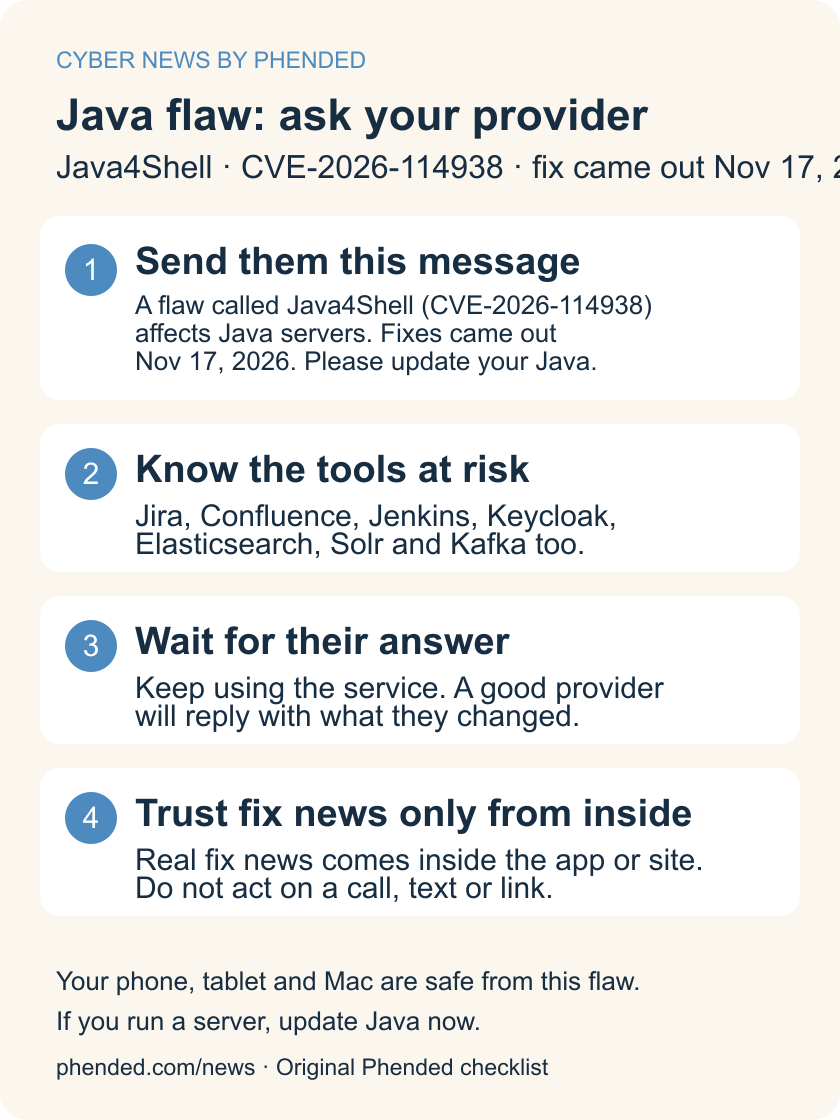
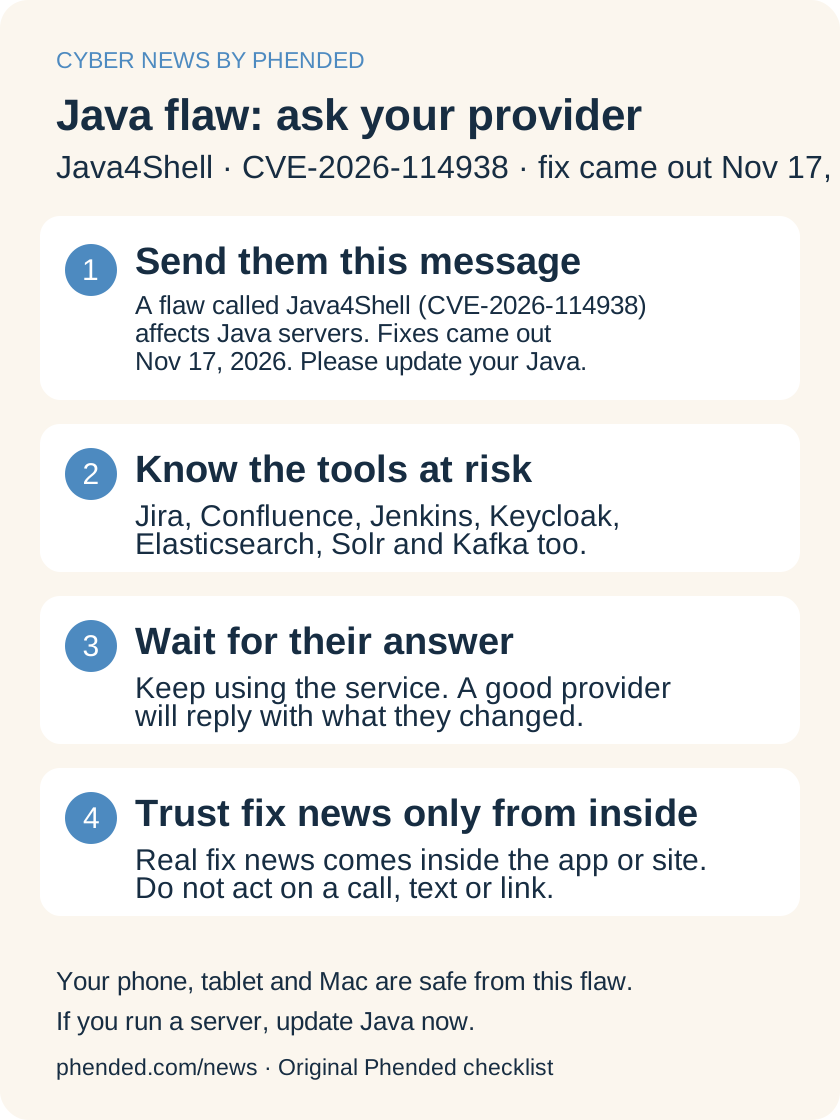
Researchers showed working attacks against popular business tools. The list includes Jira, Confluence, Jenkins, and Keycloak.
Oracle, which owns Java, and the OpenJDK project published fixes on November 17, 2026.
The attack works only on computers with certain newer Intel or AMD chips.
Canada's Cyber Centre published a warning the same day. It said it had seen no real attacks yet.
A researcher group called Calif found the flaw with AI help. A June bug report about the same problem had gone nowhere.
Sources: Java4Shell: Write once, RCE everywhere (CVE-2026-114938); Oracle Critical Patch Update Advisory - November 2026; AL26-029 - Critical vulnerability impacting Oracle Java - CVE-2026-114938
Who’s affected
Your phone, tablet, and home computer are probably safe. They rarely run the Java software this flaw needs.
The risk sits with servers. These are the computers that run websites, online stores, and workplace tools.
Java runs quietly behind services you may use, like banking sites, library systems, and business software.
If you pay for a website or an online service, its owner may need to update.
Apple phones and Macs do not use the chip types this flaw needs.
Sources: Java4Shell: Write once, RCE everywhere (CVE-2026-114938); AL26-029 - Critical vulnerability impacting Oracle Java - CVE-2026-114938
What to do
- Do not change anything on your phone or home computer. The flaw does not target them.
- If you pay for a website or online service, ask the provider to update Java this week.
- Use the checklist in this report. It holds a short message you can copy and send.
- If your workplace uses Jira, Confluence, Jenkins, or Keycloak, tell the person who runs it.
- If you manage a server yourself, update Java to a fixed release from Oracle or OpenJDK.
- If you cannot update yet, ask your provider to turn off Java's hardware speed-up.
- Keep your other software updated too. Old programs give attackers more ways in.
- Watch for scam messages about this flaw. Real fix news comes from inside the service.
Sources: Java4Shell: Write once, RCE everywhere (CVE-2026-114938); AL26-029 - Critical vulnerability impacting Oracle Java - CVE-2026-114938; How To Recognize and Avoid Phishing Scams
What we do not know yet
Canada's Cyber Centre knew of no real attacks when it published its warning. That can change quickly.
We do not know which services have updated their Java.
We do not know how many servers still run the old Java.
Researchers published attack details. We do not know whether criminals have copied them.
Sources: AL26-029 - Critical vulnerability impacting Oracle Java - CVE-2026-114938; Java4Shell: Write once, RCE everywhere (CVE-2026-114938)
Guides for your next step
Sources
- Java4Shell: Write once, RCE everywhere (CVE-2026-114938)
Calif
- Oracle Critical Patch Update Advisory - November 2026
Oracle
- AL26-029 - Critical vulnerability impacting Oracle Java - CVE-2026-114938
Canadian Centre for Cyber Security
- OpenJDK Vulnerability Advisory: 2026/11/17
OpenJDK
- How To Recognize and Avoid Phishing Scams
US Federal Trade Commission